Archive for the ‘Culture’ Category
Tax The Old
Productivity has skyrocketed in the past three decades, but all of the surplus has been captured by the top 1%. Wages have been flat. The workforce has lost a lot of leverage due to the cost savings of machines, labor competition with the third world and the migration of women into the workforce.
All of these extra workers are fighting for fewer and fewer jobs. The only solution is to create many more jobs or reduce the number of available workers. In the past that balance has been restored by things like disease, war, genocide and shipping people to Australia. Given our current sensibilities, we would probably do better to use the tax code.
Taxes are controversial. Conservatives argue against taxing income, saying that it is a disincentive to work. Liberals argue against taxing consumption as it disproportionately affects the net consumers – the poor and middle class. Libertarians argue against taxing anyone because they don’t understand math.
What if instead of taxing based strictly on income or consumption, we set tax rates based on age.
How it works:
From age 0 to 40 your tax rate is 10%.
Starting at 40, after a standard deduction at just above the poverty line, your tax rate is your age. ie. A 40 year old pays 40% of his income above the deduction, a 60 year old pays 60%.
Why Tax The Old?
Not taxing the young incentivizes them to work and to save. It’s the cheapest money you will ever get so it makes sense to sock it away now. It discourages the young from frittering away years in college. Instead they will want a degree or certification they can use now.
Taxing the old disincentivizes them to work. It encourages early retirement, except for the very highly skilled who can be compensated highly enough to offset their extraordinary tax burden.
It encourages job growth as it reduces the pool of workers, but reduces it at the top not the bottom. So young workers will be highly sought after as they are less expensive and more eager to work.
This also encourages older workers to leave the work force and spend their time creating value either by helping their working children with home life, volunteering or starting businesses that pay in equity and investment income, not salary.
If nothing else it will force the accumulation machines we call corporations to push profits back into the hands of the workers by tightening the labor market and raising the price of expertise closer to its true value to the employer.
Just so we’re clear: What is Satire?
For You Mamasita
Corpo de Mujer
Cuerpo de mujer, blancas colinas, muslos blancos,
te pareces al mundo en tu actitud de entrega.
Mi cuerpo de labriego salvaje te socava
y hace saltar el hijo del fondo de la tierra.
Fui solo como un túnel. De mí huían los pájaros
y en mí la noche entraba su invasión poderosa.
Para sobrevivirme te forjé como un arma,
como una flecha en mi arco, como una piedra en mi honda.
Pero cae la hora de la venganza, y te amo.
Cuerpo de piel, de musgo, de leche ávida y firme.
Ah los vasos del pecho! Ah los ojos de ausencia!
Ah las rosas del pubis! Ah tu voz lenta y triste!
Cuerpo de mujer mía, persistiré en tu gracia.
Mi sed, mi ansia sin límite, mi camino indeciso!
Oscuros cauces donde la sed eterna sigue,
y la fatiga sigue, y el dolor infinito.
Vente poemas de amor y una cancion desesperada - Pablo Neruda, 1924
Body of a Woman
Body of woman, white hills, white thighs,
you look yourself like a world in your attitude of surrender.
My rough peasant’s body digs in you
and makes the son leap from the depths of the earth.
I was alone like a tunnel. The birds fled from me
and the night enveloped me with its crushing invasion.
To survive myself I forged to you like a weapon,
like an arrow in my bow, like a stone in my sling.
But the hour of vengeance falls, and I love you.
Body of skin, of moss, of eager and firm milk.
Ah those goblets of the chest! Ah those eyes of absence!
Ah the roses of the pubis! Ah your voice slow and sad!
Body of my woman, I will persist in your grace.
My thirst, my unbounded desire, my uncertain road!
Dark river-beds where the eternal thirst follows,
and tiredness follows, and the infinite ache.
Twenty Love poems and a song of despair - Pablo Neruda, 1924
Christopher Hitchens Lived

I always knew there was a risk in the bohemian lifestyle… I decided to take it because it helped my concentration, it stopped me being bored — it stopped other people being boring. It would make me want to prolong the conversation and enhance the moment. If you ask: would I do it again? I would probably say yes. But I would have quit earlier hoping to get away with the whole thing. I decided all of life is a wager and I’m going to wager on this bit… In a strange way I don’t regret it. It’s just impossible for me to picture life without wine, and other things, fueling the company, keeping me reading, energising me. It worked for me. It really did.
– Christopher Hitchens 1949 – 2011
falling back
I like daylight savings time because it reminds me that my perception of time is a completely arbitrary abstraction based on the base 60 / 12 number system of a dead civilization which I have to translate into base 10 numerals in my head because my ancestors never thought to use their closed hand as one and six, but that’s ok because they are both, in turn, just arbitrary abstractions.
Why Start Up In Saint Louis?
Traditionally, St. Louis has made its fortune on the rivers. It’s easy to see why. Sitting at the confluence of the two largest rivers in North America, during the height of the river trade, St. Louis attracted immigrants from all over, new businesses and even a shady scheme or two.
However, as America has moved to over the road trucking and air cargo, the leverage that St. Louis’ location afforded the city began to wane. Since then, the city has used a more diversified basket of features to entice investors and businesses to grow our local economy.
The fate of every city is intricately wrapped up in its geography. The unique geographic features of cities like the shipping ports of New York and New Orléans, the prairie isolation of Omaha and the central location of Chicago have always been the major driver of the regional economies.
One unique example is the San Francisco bay area — particularly the J shaped strip of towns we collectively call ‘Silicon Valley.’ The area is interesting because their geographic advantages seem more social than geologic.
It is a beautiful place. That much at least is unambiguously attributed to its location. However, the major economic draw is the result of a series of fortunate accidents including government military spending, well-financed and widely available higher education, openness to immigration and cultural diversity and other features that have entangled into a feedback loop that results in the Valley being where America goes to invent stuff.
It is a real advantage. The silicon valley is where the money is. The money is there because the entrepreneurs are there. They are there because of the great schools, weather and, of course, the money. There’s also The Network. Though Steve Jobs’ famous license plate-less Mercedes is no longer parking in their handicap spots, the cafés, bars and noodle shops up and down the valley are full of people chatting, dreaming, lying and scheming. Everywhere you look another young entrepreneur is hustling his way down the block while another emails her lawyer another stack of impenetrable documents.
Things are happening in the valley because people have come there to make things happen.
Are things happening in St. Louis?
Have you been down to Cherokee street? If not, you owe yourself a taco so go down and take a walk around. You will see little businesses growing up between the Taquerias and check cashing joints. There are startups bootstrapping their way up above art galleries and at tables in communist bakeries.
There aren’t any big VC offices. You won’t find investment bankers or opportunistic MBAs. There’s a few Rockstar Programmers, but they’re actually programmers in rock bands. You’ll find new sites like StartLouis.com and hacker spaces like the Arch Reactor. There are creative people tooling around in their custom and inexplicably illegal food trucks.
Music, community, cheap rent, World Series winning baseball teams, smart people, cool hangouts – Saint Louis has a lot to offer. It’s also, for a lot of innovators and creators, home.
It used to be, when a young man needed to find his fortune, that he would pack up his belongings and hit the road. Opportunity was limited and hard to find. As we entered the industrial age, cities exploded into sprawling, soot covered opportunity engines. Economic opportunities increase in tight correlation with individual’s opportunity to interact with each other. As the number of nodes in the network increase, the value of the network to each node grows exponentially. On the flip side, the value of each node is correlated with how many connections it has to other nodes, either through many weak direct connections or a few strong connections to other highly connected nodes. It really is all about who you know and, by extension, who they know.
The tightly connected cities stretched out and connected with each other in stages including trains, telegraphs, telephones and highways. Finally, in an unprecedented whirlwind of copper cables, fiber optics and finally persistent personal wireless strands that connect us to each other in pools of actionable market data.
That tightly wound network of investors, institutions and entrepreneurs in the Silicon Valley is likely to experience something like what St. Louis went through when the man-made networks of first the Railroad and then the highway system suddenly devalued the river network.
Those were networks with more nodes and edges than the relatively sparse river ports. That added value is clear when you see how quickly rail and road replaced the riverboat.
The ad hoc networks that are springing up across the internet are challenging the old gatekeepers. Instead of supplicating on Sand Hill road, you can run a Kickstarter campaign or use lean methods to bootstrap your idea into an MVP on South Grand or Delmar or Cherokee Street. Being funded is still a big advantage. You can bully and buy your way into viability if you’re funded and the right combination of ruthless and lucky. But in a pinch you can be scrappy and clever make up for whole choirs of Angel investors.
I don’t want to downplay the significant advantages the Silicon Valley can confer on a hot startup. You can build companies in the Valley in a time-frame and scale that would be hard to replicate elsewhere. However, you can build a company in St. Louis on a scale and time-frame that would be unthinkable out west.
Everyone is preaching the gospel of metrics, experimentation and optimizing your way to profitability. Have you noticed that all the big funded companies are experimenting on the same things? Some of the experiments are about validating the hobby-horse of a particular investor and others are CYA experiments in doing whatever is on the home page of TechCrunch today.
When you’re operating at an outlandish scale with other people’s money you have a limited range of experimentation you can get away with. Everyone will get behind seeing if you can pretend to be Groupon for a while and moving the needle a couple of points one way or the other with a different colored button is a productive use of your time when your visitor logs look like pro football attendance records.
What you can’t do is experiment with the premise of capitalism itself. You can’t just paste together a pastiche of open source software without a marketing plan. You can’t trade beer for code. Well, you can… we just have better beer.
We’re living in a world where is often takes a disaster like a tornado, earthquake or hurricane to remind us of how much where we are affects who we are. When I was a kid we heard rumors that kids in California wore fashions we wouldn’t be aware of for a couple of years. We dreamed of growing up and running off to New York to be in the center of it all.
Now there isn’t a center. We’ve agreed to search not sort. The traditional way of making a fortune was to secure exclusive control of a node or two of a large system. Industrialization and electronic communications allowed for control of more and more nodes, and even entire systems. The early trusts were the natural end of that progression.
We’re reaching what, optimistically, is the peak of our current cycle. The computer’s ability to exploit information for monetary gain has reached a point where winners and losers are decided by CPU cycles and, literally, the speed of light.
Having value created virtually on a network that doesn’t respond to scarcity like its real world proxies has been an interesting experiment and it has led to some outlandish results like credit default swaps being sold for more than the GDP of the planet.
On a happier note, one of the things created in the wake of our sudden and ubiquitous interconnection is the opportunity to use information in novel ways from anywhere. When the internet first left the academic and military cloisters it was born in, we experienced a sudden burst of innovation that almost outran itself. As the network’s physical infrastructure has caught up to demand, we’ve seen a more rationed growth in innovation. Somewhere in the last few years we reached a tipping point. Mobile networks have expanded to reach of the network to a saturation level unimaginable just a decade ago.
Do you remember Jott? As I barely remember it, it was a service that allowed you to store notes and ideas and todo lists in a personal space on their website. It was attractive then because it allowed you to connect to the world wide network in that “last mile” when you weren’t physically in front of a connected computer. The smart phone rendered Jott irrelevant instantly. Instead of running a custom line that last mile, the mobile networks brought the internet itself to your pocket.
That network saturation level is a seismic event in human history. The network is expanding at a rate closely approximating the growth of information itself. According to some interpretations of network theory, the value of the network is growing exponentially to that rate. That’s a pretentious undergraduate way of saying that it is getting easier and easier to capture the value created on that network.
As that happens, it becomes easier to take advantage of the resources available in St. Louis. A couple of decades ago, creating a tech startup in Saint Louis was so arduous as to be nearly impossible. As evidence I present a list of notable tech startups from St. Louis in that time period. (I don’t have a list, I’m sure there are some. But that’s my point.)
Back then you didn’t have access to the information, equipment and money that a silicon valley company had. You also didn’t have a deep network of fellow entrepreneurs. Even if there were a sufficient number of peers, finding each other and coordinating meetings was a challenge unto itself.

Now, we can connect with each other instantly by location and interest. We can read streams of each others thoughts before ever meeting! Now we can download open source software that does all the stuff you needed money and employees for in the past. Now we have free information and tutorials that will teach you skills that the best universities could not teach you at any price. You can ask questions of experts and receive instant answers. You can build something cool and people can share it with a twitch. Before you know it people from all over the world are cloning your repo, or signing up for your MVP or reading your rambling blog posts.
The value of any one of those things is incalculable. The best way to estimate their value is to use them.
- Start connecting with people who know how to make things
- Develop a habit of sharing what’s on your mind online
- Make plans and schemes at Cartel or Mokabe‘s or Kaldi‘s.
- Celebrate a release with some Ted Drewes.
- If someone whines about moving to the valley, ask them how the Giants did this year. Cough cough.
St. Louis is a great place to start a business because it’s our home. We live in a unique time in which, for better or worse, we’ve been asked to release the alpha version of the Human Network Operating System. For some reason, most of it is being written in Javascript and PHP.
St. Louis is a great place to start a business because it’s full of people who think it’s ok to be creative. We let our children play on a rusted out airplane attached to the side of an old shoe factory. In a city famous for its brick buildings and centered on the regal architecture of the courthouse we installed a 630 foot stainless steel arch. Have you had a pork steak? I’m just saying we’re willing to try new things.
Our state sobriquet is the “Show Me State.” It’s essentially an ode to data driven innovation. It’s not hard to convince a Missourian of the value of market validation.
At the same time, there is another essential character trait that helps drive innovators in this region. It’s a default openness to just rolling with it. Think about our regional specialties. Gooey Butter cake was invented, the legend goes, when a baker reversed the proportions of sugar and flour in a standard yellow cake recipe. Instead of throwing out the gooey and gloppy failure, she just rolled with it. Gooey is now a feature not a bug. Problem solved.
Not convinced? What other weird stuff do we eat here? Toasted Ravioli? A chef accidentally dropped an order of ravioli in a deep fryer and just rolled with it. It’s fine, just dip it in the sauce.
Monsanto was trying to make a serum to create an army of super soldiers but spilled the secret formula on some weeds that shriveled up. The army of super soldiers drowned during a float trip on the Meramec river but Roundup makes billions. Rolled with it.

The economy is in transition. It will be a bumpy ride in many places. Having a tendency to tenacity and curiosity is a great combo now. St. Louis was largely insulated from the fallout of the housing crisis. Driving around the city now you will see new businesses growing in the rugged remains of old industries. You’ll see big buildings that don’t seem to be used for anything but inside are humming thousands and thousands of servers taking advantage of our location and Washington University’s historic role near the backbone of the internet. You will see creative businesses like the Cherokee Photobooth and Upcycle Exchange are exploring entire new business models.
Sucking the marrow out of dying power structures is a perfectly rational strategy as the perfectly rational sociopaths on Wall Street are all too eager to prove. Creating the future is a much riskier strategy but never has it been more accessible and more rewarding. St. Louis is a great place to try to build the future.
Also, we have frozen custard.
Photo Credits: CC licensed photos from http://www.flickr.com/photos/paparutzi/ and http://www.flickr.com/photos/dherholz and http://www.flickr.com/photos/janet/
Regarding our current economic policies…

If thou seest the oppression of the poor, and violent perverting of judgment and justice in a province, marvel not at the matter; for he that is higher than the highest regardeth, and there are higher than they.
Moreover the profit of the earth is for all; the king himself is served by the field. He that loveth silver shall not be satisfied with silver, nor he that loveth abundance with increase. This is also vanity.
When goods increase, they are increased who eat them; and what good is there to the owners thereof, except the beholding of them with their eyes?
The sleep of the laboring man is sweet whether he eat little or much, but the abundance of the rich will not permit him to sleep.
There is a sore evil which I have seen under the sun, namely: riches kept for the owners thereof to their hurt. But those riches perish by evil travail; and when he begetteth a son, there is nothing in his hand.
As he came forth from his mother’s womb, naked shall he return to go as he came, and shall take nothing of his labor which he may carry away in his hand.
And this also is a sore evil: that in all ways as he came, so shall he go. And what profit hath he that hath labored for the wind? All his days also he eateth in darkness, and hath much sorrow and wrath with his sickness.
Behold that which I have seen: It is good and comely for one to eat and to drink, and to enjoy the good of all his labor that he taketh under the sun all the days of his life, which God giveth him; for it is his portion. Every man also to whom God hath given riches and wealth, and hath given power to eat thereof and to take his portion and to rejoice in his labor, this is the gift of God.
For he shall not much remember the days of his life, because God answereth him in the joy of his heart.
Ecclesiastes 5:8-20
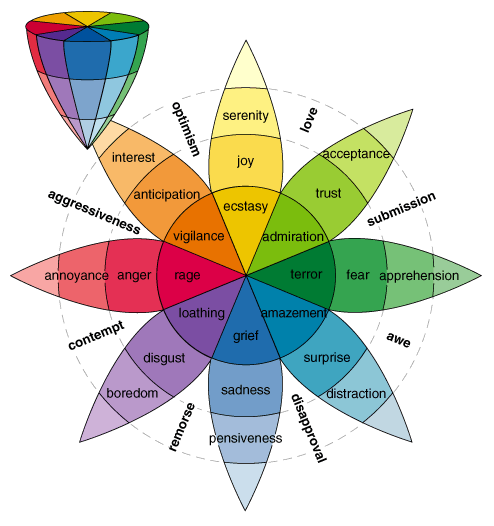
Matrix of Emotions
I saw the image below recently and was intrigued. Unfortunately I saw the image without context so I couldn’t figure out what to google to learn more. The other day, however, I ran into it again. Here’s the explanation I found:
Robert Plutchik considered there to be eight primary emotions – anger, fear, sadness, disgust, surprise, anticipation, trust, and joy. Plutchik proposed that these ‘basic’ emotions are biologically primitive and have evolved in order to increase the reproductive fitness of the animal. Plutchik argues for the primacy of these emotions by showing each to be the trigger of behavior with high survival value, such as the way fear inspires the fight-or-flight response.
Ten Postulates of Emotion
Plutchik’s psycho-evolutionary theory of basic emotions has ten postulates:
- The concept of emotion is applicable to all evolutionary levels and applies to animals as well as to humans.
- Emotions have an evolutionary history and have evolved various forms of expression in different species.
- Emotions served an adaptive role in helping organisms deal with key survival issues posed by the environment.
- Despite different forms of expression of emotions in different species, there are certain common elements, or prototype patterns, that can be identified.
- There is a small number of basic, primary, or prototype emotions.
- All other emotions are mixed or derivative states; that is, they occur as combinations, mixtures, or compounds of the primary emotions.
- Primary emotions are hypothetical constructs or idealized states whose properties and characteristics can only be inferred from various kinds of evidence.
- Primary emotions can be conceptualized in terms of pairs of polar opposites.
- All emotions vary in their degree of similarity to one another.
- Each emotion can exist in varying degrees of intensity or levels of arousal.
Fathers, don’t frustrate your children…
It was late at night and I was standing in my kitchen, cooking bacon and crying.
I was cooking bacon because I was hungry and I had bacon. When those two conditions are true it’s not at all surprising to find me in the kitchen cooking. The crying, however, was new. It had taken me by surprise.
It had been a stressful and snarly night. I had come home from work tired and cranky. Shortly after I’d arrived Amanda came back from the pool with the boys. Sagan, the baby, was fussy and tired. Max was excitedly telling me all the things he had seen and thought of that day. If you’ve ever had a conversation with a seven year old you know that they can be a little hard to follow. I tried to imitate interest with frequent nods and encouraging interjections.
As everyone settled down, Amanda took Sagan off to sleep, I started to prepare dinner and Max turned on the Wii. Ten or fifteen minutes later, I was wrapping up my cooking and called Max in to clear the table and set it for dinner. We’ve recently introduced a chore chart and those tasks are the centerpiece of his evening routine.
He had only just started to play his game. He didn’t want to get up and go do his chores right as he was getting into it.
He complained.
I ordered.
He whined.
I threatened.
He cried.
I banned him from video games for a month.
He collapsed.
He ran to his room and cried under his covers.
I set the table in silence.
We got through a quiet and grumpy dinner. He was sullen and didn’t talk much. I didn’t have much to say. The rest of the evening plodded on like that. He went to bed and the whole house got very quiet.
That’s when I got hungry. I hadn’t eaten much at dinner. My appetite had been soured by the conflict. I went into the kitchen and frowned at the leftovers from dinner. I looked in the fridge. I found a couple slices of bacon and some lettuce. It looked like the start of a good salad.
As I got a plate down from the shelf, I thought back to the incident earlier. I thought about what it looked like from his perspective. It’s been a long time since I was a seven year old, but I can remember a bit of what it felt like.
I remembered that when you’re seven you don’t get pick what happens next. You can ask but you know that you’re not in charge so often you’ll take what you can get. Sometimes that means you’ll get to go to the park, other times it means you get dragged to the supermarket.
When you’re seven you get excited about all the new things you’re learning. You can’t wait to tell your parents about it, but grown ups don’t listen much when you talk because those things aren’t new to them. You’re just learning how to hold a conversation but adults keep interrupting you with corrections of your facts or grammar.
The grown ups always seem to be too busy to play. They’ll admonish you for wasting your time on cartoons and video games. But they won’t object too much if it keeps you quiet while they’re distracted with facebook and twitter.
Perhaps the most frustrating thing is that the grown ups don’t remember what it’s like to be seven. They don’t understand how something like a video game or a cheap toy can be so important to you. They don’t remember how long a day, a week or a month is to you. They’ll dish out devastating and arbitrary punishments in anger and there’s nothing you can do about it.
When you’re living with so little control of your own life, it’s essential that your parents provide a consistent structure of rules, expectations and consequences. The rules shouldn’t change just because your dad had a bad day.
I thought about that and I cried. I had come home worn out and disengaged. I hadn’t listened to him or played with him. Lego Indiana Jones had at least played with him that day. And now I was taking that away just because he wasn’t setting the table with enough enthusiasm.
I turned the heat down on the stove and went into his room. He was asleep in the tangled up manner of skinny boys. I knelt down close and whispered “I’m sorry.”
He half woke up and mumbled something. I told him again I was sorry and that I was unfair to take away his games like that. I told him I loved him and wanted to be a good dad. He closed his eyes and rolled over. I wasn’t sure he’d heard me.
The next morning on the way to school I repeated my apology. He said he had heard me the night before. I told him he still had to do his chores and he wouldn’t be getting his allowance for yesterday. He said ok. I looked at him through the rear view mirror.
He smiled.
Notes:
The images are from DoubleM2′s photostream on flickr. Used in accordance to the creative commons license
The title is a paraphrase of Colossians 3:21, “Fathers, do not exasperate your children, so that they will not lose heart.”
Practical Imagination: An Essential Startup Skill
I was thinking today about the “soft skills” of business and particularly entrepreneurship. Much is made of the often amorphous “business skills” or “people skills.” For technical people those phrases are often heard as a euphemism for either an eagerness to take advantage of people or, just as often, moderate alcoholism.
We joke among ourselves about the starry eyed “idea guys” that post on craigslist looking for someone to just “do the code part.” As if developers are sitting in front of their keyboards watching the cursor blink on a blank screen as we curse, “If only I had an idea!”
Of course, people who know how to do stuff are biased toward the doing end of things. They know how much more difficult it is to implement an idea in the real world compared to imagining the idea in the controlled lab of your brain. A common trope among developers is the Underpants Gnome business plan that looks like this:
- Collect Underpants
- ?
- Profit
We chuckle at the naivety of jumping into a plan without thinking about the implementation. It’s something that we experience in real life when we’re approached by someone waving NDAs and so enamored with a half-baked idea they haven’t dared to question it. They usually gloss over the hard parts like acquiring traffic, engaging those clicks enough to convert them into customers, and, of course, writing the software.
It’s not the idea, it’s the execution. Mostly.
But it’s the idea too, right? When we hear the folk tales of startups and entrepreneurs, we invariably hear the “origin of the idea.” Typically, amid a mess of wires and empty soda cans cluttering a garage sit bleary eyed, sleep deprived hackers who are singularly obsessed with “the idea.” The idea might seem like madness to those around them, but these visionary souls have seen the future and in a flash of preternatural insight have become obsessed with a quest to fulfill it.
Well, the good stories go like that at least.
In a more sober mood, we can perceive the other mitigating and amplifying factors like the commoditization of complements, under-exploited efficiencies born out of new technologies and their side effects, and often opportunities that arise due to luck, nepotism, political power shifts or a combination of the above.
We can thumb through back issues of business magazines and see the burned out wrecks of businesses that all started as good ideas. How many of them fell apart because “the idea” was not good enough? Often we’ll find that they failed because of personality conflicts, cash flow issues, bad partnerships, inadequate capital, a changing market or any of the million other reasons only tangentially related to the core idea.
Still, it’s the idea that gets us.
It seems like the ideas are the difference between the winners and the also rans. It seems like it should be at least. The idea is the romantic part. We love the idea because it means we don’t have to be born rich or well connected. It means that cleverness counts and that’s attractive because cleverness is fair.
Ideas also seem disproportionately important because the founders that are left standing in successful startups are usually the sort of people that have lots of good ideas.
The ideas that they come up with to solve the problems that capsize their competitors are often not particularly novel or complicated. And they’re almost never the first idea that was tried.
What distinguishes the wanna-be from the game changer is not how big his very biggest idea is. It’s his skill in imagining practical solutions to all the little problems that have to be solved every day.
Practical imagination is a skill. Like every skill some people bring a talent to the table that puts them leagues ahead of the average joe. However, like every skill it has to be practiced regularly or it will erode and dull. If you go to work with a dull and misused imagination you will quickly get overwhelmed with all the weed-like issues that take root when you lack the ability to anticipate them.
How do you practice your imagination?
You might be hoping the answer is regular day dreaming and hallucinogens. Others will probably insist the only answer is regular exercise (I kid!) However, the only real answer is to run into a lot of problems that need solutions. The best way to run into a lot of problems is to try to do something hard.
It’s important to distinguish between hard and impossible. If you jump into doing something impossible, it’s likely you’ll learn a lot. It’s guaranteed that you will fail. Now failing isn’t the worst possible outcome. Not trying is usually worse. At the very least, when you try and fail you learn that doing it that particular way doesn’t work.
If you want to occasionally have something to show for your efforts, you should aim for just hard. However, if you’re new or out of practice it might be difficult to tell the difference. What you do in that case is analogous to how you start lifting weights. One of the quickest ways to crash a fitness regimen is to bite off more than you can chew and hurt yourself. So what do you when you start lifting weights? You start with the empty bar. It may be the case that you’ve managed to sock away enough strength in those chubby arms to lift more than the empty bar. You’re not going lose anything by starting too low. You will definitely gain something – the knowledge of what you’re capable of.
In the same way, in business you can dream of solving the big problems. If you’re a developer, you can imagine crafting a smoothly running application with next generation features and elegant algorithms. But if you’ve never gone so far as to stand up an install of wordpress, you might want to trim your scope a bit. Start with something you can do in one iteration. Chop out every nice-to-have, strip out the clever bits, make do with the barest list of deliverables. It doesn’t have to solve every edge case. Just solve one.
Once you do, step back and take a look. You may have a rickety little jalopy of code that runs… mostly. It certainly won’t look much like what you pictured when you first dreamed it up. But it’s real and it works. I’ll bet it looks a lot more like what you envisioned than nothing does. Doing that much is more than the vast majority of wishers and hopers will ever accomplish.
The Happy Side Effect Of Doing
On top of a sense of accomplishment, one of the most valuable things that actually doing something will give you is a list of problems. Perhaps you didn’t think about saving some important data, or you realize that your sign up form is hard to use. When you have an understanding of what sort of problems need to be solved you have insight that far beyond that of even the most visionary thinkers.
On a practical level, you also have a list of opportunities to practice your imagination. Instead of idly day dreaming about how you’d solve the problems you wish you had, you have to test and try and fiddle and tweak until you graduate to a whole new set of problems.
It gets easier. As you gain experience you start to learn how to recognize problems. You’ll learn what sort of problems can be ignored, which are best beaten to death with money and which problems are worth changing your whole direction for.
Becoming familiar with problems is really just an abstract way of describing how you acquire a skill. When we say a mechanic is skilled at fixing automobiles we are saying that he knows what problems cars have and how to deal with them. The same goes for plumbers and architects and bakers and forest rangers.
For someone involved in startups and new technology, besides the practical skills of writing code, managing time, composing ad copy and the like, the most important skill you can have is a sharp, practical imagination.
You have to be able to anticipate problems early enough that you can adapt your trajectory to use them as opportunities.
I emphasize the world practical because there’s a difference between imagining what might happen and imagining what else might happen. A practical imagination is one that can be used as a tool.
Often when wedded to a big idea we fall into the trap of insisting on the original destination even after the journey has uncovered previously unimagined treasure ahead. It takes flexibility to pivot. People who aren’t comfortable solving unanticipated problems aren’t flexible.
To be flexible, you have to be good at anticipating problems three moves out or able to duck really fast. Either way you’re going to have to be skilled at guessing what might come next. That’s a practical imagination.
Squeezing The Wonder Out
Does this sound like a grumpy old man kvetching about those wide-eyed kids and their big dreams? I’m not trying to argue for limited dreams and austere ambitions.
It’s ok, even admirable, to dream big. It’s not ok to have an imagination limited to the party at the end of the road.
It’s easy to point to a mountain peak and say, “I’m going to get to the top of that.” What is hard is negotiating the bramble, rocks, gorges and poison ivy that you’ll encounter on the way up. It’s the guy that can invent shortcuts and forge new trails that’s going to get there first.
Your friends and family, the press and other on-lookers will applaud the novelty of your invention. Your fellow hackers and do-ers will applaud the tenacity, cleverness and endurance it took to implement it.
The Scrappy Sage
So what are you looking for on the “idea” side of a new business? I think you have to find a balance. Without a big vision you are unfairly limiting your ambitions. You have to have a story that people can share, that investors can grok quickly enough to read past the first page and that developers can aim for. Having a big idea is a requirement for building a business that is solving a problem big enough to warrant survival.
Balanced against that big idea is the pile of little hacks, epiphanies and pivots that you have to make as you scramble up your mountain.
The best people you can find to partner with are the ones with enough callouses on their finger tips to prove they’ve scaled a cliff or two. They know better than to gloss over the frustrating and exhausting bit in the middle.
How do you recognize those people? Here are a couple things to look for:
- They are suspicious of features. Every new feature of a product costs time and attention and introduces risk. People who are quick to add to the spec are often either too enamored with their own ideas or lack a healthy fear of scope creep. People who insist on doing the absolute minimum in the first iteration, on the other hand, aren’t exhibiting laziness. They are likely showing you that they understand how difficult it is to do things even when they’re simple to imagine. There will always be time to add and improve to the product.
- They question assumptions. If you are bringing nothing to the party except ideas it’s scary when people kick the tires of your idea. If the idea isn’t sacrosanct than what do the others need you for? People that make things want to know what they’re going to run into down the line. If someone can’t see the value in testing and tearing apart the idea it is prima facie evidence that they’ve never properly implemented one.
- They have finished projects that you can see. Before you commit your time and treasure to a project or business, you need to see some evidence that your partners have seen something through. Work done for other people is a good start. Things they made on their own are better.
Having a practical imagination means having the confidence to try out your ideas, the humility to abandon the ones that don’t work and the flexibility to adapt and grow. Finding people with staggering intellects or bulging business contacts is a big advantage for a startup; finding people that know how to get things done is even better.
Life Is Short
So it is — the life we receive is not short, but we make it so, nor do we have any lack of it, but are wasteful of it. Just as great and princely wealth is scattered in a moment when it comes into the hands of a bad owner, while wealth however limited, if it is entrusted to a good guardian, increases by use, so our life is amply long for him who orders it properly.
Lucius Annaeus Seneca, On The Shortness Of Life
You know, some people say life is short and that you could get hit by a bus at any moment and that you have to live each day like it’s your last. Bullshit. Life is long. You’re probably not gonna get hit by a bus. And you’re gonna have to live with the choices you make for the next fifty years.
Chris Rock, On The Longness Of Life
‘Well, maybe it is true,’ Clevinger conceded unwillingly in a subdued tone. ‘Maybe a long life does have to be filled with many unpleasant conditions if it’s to seem long. But in that event, who wants one?’
‘I do,’ Dunbar told him.
‘Why?’ Clevinger asked.
‘What else is there?’
Joseph Heller, Catch-22
And who of you by being worried can add a single hour to his life?
Jesus

There’s a very old joke that goes something like this: Two old ladies are discussing a restaurant. “The food there, it’s terrible.” Says one. The other nods vigorously, “Yes, and such small portions!”
I’m willing to bet that joke is funny in most languages and cultures. The premise is universal – why would you want more of something you don’t like?
When you’re talking about the rubbery chicken at Le Chateau Blanc of the Catskills it’s one thing; when you’re talking about struggling to make it day to day under the burden of depression or grief, it’s another thing entirely.
When most people think about the word “stoic” they picture a stone-faced, unemotional person. I’m pretty sure that’s the accepted definition of the English word. That isn’t an accurate picture of the philosophy of that name. The Spock like indifference is a caricature drawn by opponents. That idea is derived from the stoic idea of accepting and appreciating pain and misfortune.
What Seneca was arguing for was not a grim existence where you toil under a hot sun and eschew the fun parties you’re invited to because you’re far too deep and brooding to smile. That’s a popular interpretation among young men who deal with their insecurity and fear of rejection by becoming heady little cranks.
Instead, he wanted us to consider what really brings joy and satisfaction to our short lives. In his essay On The Shortness Of Life he describes the busy but empty lives of the social strivers around him. He talks about those who speak longingly of their retirement and the foolishness of living an empty, scattered life in hope for a few years of reflection at the end.
Spending Your Time Wisely
Those who complain about the shortness of life are like the people that spend their entire paycheck on silly things they don’t even want and then whine about not having enough money.
This is where the caricature comes from. Our brains are so wired that the things we value most are the things that are valued by others around us. Our culture values status, consumer goods and entertainment. When someone points out that a life spent in front of a television contemplating brand name baubles is barely worth living, we will agree of course, and likely change the channel because that is such a boring and uncomfortable idea.
Listen to Seneca:
But one man is possessed by an avarice that is insatiable, another by a toilsome devotion to tasks that are useless; one man is besotted with wine, another is paralyzed by sloth; one man is exhausted by an ambition that always hangs upon the decision of others, another, driven on by the greed of the trader, is led over all lands and all seas by the hope of gain; some are tormented by a passion for war and are always either bent upon inflicting danger upon others or concerned about their own; some there are who are worn out by voluntary servitude in a thankless attendance upon the great; many are kept busy either in the pursuit of other men’s fortune or in complaining of their own; many, following no fixed aim, shifting and inconstant and dissatisfied, are plunged by their fickleness into plans that are ever new; some have no fixed principle by which to direct their course, but Fate takes them unawares while they loll and yawn—so surely does it happen that I cannot doubt the truth of that utterance which the greatest of poets delivered with all the seeming of an oracle: “The part of life we really live is small.”
The issues weren’t any different in his day. Look at the table below, I’ve separated out who in our time and culture he is describing:
| People Who Are: | Modern Exemplar |
|---|---|
| Possessed by an avarice that is insatiable (People obsessed with getting richer as an end to itself) | Wall Street bankers and hedge fund managers |
| Toilsome devotion to useless tasks | Farmville Players |
| Besotted with wine | Bar Flies and Crack House Residents |
| Paralyzed By Sloth | People that rent moving carts to avoid having to walk around Walmart |
| Exhausted by an ambition that always hangs upon the decision of others | Sports Fans, Talk Radio Screamers |
| Driven on by the greed of the trader, is led over all lands and all seas by the hope of gain | George Clooney in that airport movie |
| Tormented by a passion for war and are always either bent upon inflicting danger upon others or concerned about their own | War Bloggers, Terrorists, Republicans |
| Worn out by voluntary servitude in a thankless attendance upon the great | Fans of Pop Stars, Gossip and Celebrity Junkies |
| Kept busy either in the pursuit of other men’s fortune or in complaining of their own | Employees of most large corporations |
| Following no fixed aim, shifting and inconstant and dissatisfied, are plunged by their fickleness into plans that are ever new | Um… me. |
| Who have no fixed principle by which to direct their course, but Fate takes them unawares while they loll and yawn | Almost everyone |
That’s a pretty comprehensive list of ways to waste your life. What is the common attribute shared among those groups?
They are distracted by advertising, flickering screens, whispers of their neighbors, physical craving for food, sleep and drugs. They are being persuaded to trade their time for stimulation and status.
It’s not a fair trade.
The most valuable thing you possess is time. You spend your time with your attention. Anything that clamors for your attention is implicitly asking you to trade moments of the only life you’ll ever have for what they are offering.
Sometimes we have no choice. You have to go to work, you have to clean and cook and do all the things that keep you alive and in good health. The only problem we encounter with those things is when we’re doing them without being mindful. Why do you go to work? To make money, of course. But why do you make money? What is the goal? Are you at a job where you flick your brain off when you clock in and just muddle through the day until quitting time? Are you ok with trading that much life for the money you get? The answer might very well be yes. You probably have babies to feed or other responsibilities. The point isn’t that everyone should quit their jobs and sit at home contemplating the universe. The point is to be mindful of the time that is passing and how you’re spending it.
Make A Life Budget
Every financial counselor or book about money that I’ve read has insisted that the very first thing you need to do when getting your finances in order is to craft a budget. Without writing down what you are spending your money on it is impossible to construct a plan to spend your money more effectively. You will find yourself at the end of the month wondering why there isn’t enough to pay the bills because you can’t see that you’re leaking money on take out, clothes or something else.
Once you have a framework, you can see how your habits are misaligned with your goals. You will also be able to make better goals because you have a realistic picture of what you are capable of.
In the same way, it’s impossible to get your life in order until you can see and understand what you’re spending your time and attention on. How much time do you spend on watching television? browsing facebook? talking to your kids? Reading? If you’re like most people you have no idea.
Try taking notes. At the end of the day, for a week or so, think back to when you woke up, what time you got to work, what you did there, etc. Ask yourself, am I leaking time? In the same way that I don’t want to close out the month wondering where all my money went , I don’t want to end up on my deathbed wondering where all my time went.
Another old joke – Jack Benny was famous for this one. A mugger points a gun at his chest and demands, “Your money or your life.” After a long pause, the mugger says “Well?” Benny answers, “I’m thinking! I’m thinking!”
We know that life is more valuable than money. It’s absurd to hold on to something at the cost of everything. People do it every day. We get so obsessed with accumulating money or other finite things, we eagerly trade our days and hours away. What happens at the end of life? All the status, money and treasure are worth nothing. We will willingly give it all away to hold on to life.
Figure Out What Is Important To You
When I was younger, I wanted to be rich. Well, sorta. I wanted to have enough money that I wouldn’t have to worry about money anymore. So I struggled and strived. I worked and plotted and negotiated. One day I realized that you don’t have to worry about money if you don’t want to. It doesn’t take a lot of money to live a great life. In our society, for most of us, it does take some money. Enough to acquire decent food, a comfortable house and other obligations. However, there comes a point when more is just more. How much of your life you’re willing to spend to get more is the clearest indication of what you value.
A rich man approached Jesus one day and asked about how he could enter the Kingdom of God. Jesus reply was that the man should sell everything he owned, give away the proceeds and spend the rest of his life hanging out with him. The man went away grieving because he had a lot of great stuff. Jesus has promised him that he would store up treasure in heaven, but the man had already sunk so much of his life into accumulating his possessions and the status they transferred to him. To ask him to give it all away was equivalent to asking the man to admit that he had wasted his life. That’s a lot to ask.
At another time, Jesus is quoted as saying “Where your treasure is, there your heart will be as well.” What is “your heart” in this context? It’s your attention, your values and your goals. It’s what you are spending your life on.
What does it gain a man if he spends his entire life on things that rust and decay?
What If Life Is Bad?
One more joke – A student approached the Rabbi one afternoon and asked, “Why is life so hard and filled with pain?”
The rabbi shook his head, “God will not give us more than we can bear.”
“But what if these things kill us? Is that not proof that they are more than we can bear?” the student continued.
“Eh… that’s life.”
As a healthy, employed white man in America, it’s a little rich for me to insist that everyone enjoy life to the fullest. I’ve never gone hungry, been diagnosed with cancer or ever really suffered. I’m tempted to just shrug and say “Hard cases make bad law” and be done with it.
However, I think it’s instructive to think about things like that. All of us are going to die someday. All of us will lose loved ones. What happens then? I had a friend who told me that if he was ever diagnosed with AIDS he would immediately purchase a firearm and kill himself. I told him that he would probably be surprised at how well he would cope with that news.
Humans have an amazing ability to cope with horrible things. We’ve learned that in stories from the holocaust, from hospitals and war zones.
Why don’t people just collapse when faced with such misery? I think most of it can be explained by hope. As long as we believe that things will get better, we’ll hold on.
Also, I think how we cope has a lot to do with where our treasure is. Almost every story I’ve heard from people who have faced death and disease includes a radical realignment of priorities. The treasure stored up in bank accounts and luxury goods rapidly deflates while the value of moments with your children and the bliss of being alive in this moment become invaluable.
Life can be hard. Life is often unfair. Life can be extinguished at any moment. We all know these facts. They can make you fearful. They can make you chronically nostalgic as you dwell on the memories of moments of life that you’ve already spent. They can make you immobile with worry.
What are you going to do about it? Worry, fear, anger and anxiety are feelings. Feelings are a gift. Our emotions are how we process our experiences. You can’t, however, change anything by feeling strongly about it. The only thing you can change is how you react.
How do you react to adversity? Do you try to distract yourself? Do you mope and sigh? Do you give up and collapse?
Another option is to accept that which you can’t change and try to experience the best possible life given your circumstances. Stoicism. as a philosophy, is really a toolkit for dealing with things like this. Seneca advises us to only value things that are essential. Anything that can be taken away, our wealth, status, friends, health, may be taken at any time. If you lost all of those things, what would you have left?
You have life. You have this moment. You have hope for the next moment. You have a chance to make that moment a miracle.
That’s worth more than anything.